

How to Swap Belt Buckles Without Marking Leather
A beautifully made belt should not be limited to one look. Knowing how to swap belt buckles allows you to take a favourite Italian nubuck strap from a quiet daytime finish to a more distinctive evening piece, without compromising the leather or the character of the hardware.
Interchangeable belts are designed for this purpose, but the process deserves a measured hand. Fine leather can crease if pulled carelessly, while plated, crystal or aged-metal buckles can be marked by improvised tools. A few considered movements are all that is required to refresh your belt with confidence.
Before You Swap a Belt Buckle
Begin by checking that the buckle and strap are compatible. Most interchangeable systems use a fold-back end on the belt strap, secured with either a press stud, screw fastening or a leather keeper arrangement. The buckle’s bar or prong must sit comfortably within the strap’s opening, and its proportions should suit the width of the leather.
This matters as much visually as it does mechanically. A substantial solid brass buckle can lend welcome definition to a wide full-grain leather belt, but may overpower a narrow suede strap. Equally, a fine silver-plated or crystal buckle is best paired with a strap whose width allows the detailing to remain visible rather than crowded.
Work on a clean, covered surface. A folded cotton cloth is ideal: it protects both the buckle finish and the leather’s grain while giving you a clear place to set aside small components. Wash and dry your hands first, particularly when handling pale nubuck, suede or hair-on cowhide, which can show traces of oil more readily than smooth calf leather.
Avoid forcing a buckle onto a strap because it is nearly the right size. The correct fit should feel secure but natural. If the bar is too thick, the leather is being bent sharply, or the prong does not sit centrally in the holes, choose another combination rather than risk distorting the strap.
How to Swap Belt Buckles Step by Step
Lay the belt face down, with the buckle end nearest you. Locate the fastening at the folded end of the strap. Depending on the construction, this may be a press stud hidden beneath the leather fold, a small screw, or a neatly stitched and releasable tab.
Release the strap carefully
For a press-stud fitting, support the leather close to the fastening with one hand and gently separate the stud with the other. Do not pull the strap from its tip. This places unnecessary tension along the leather and can leave a curve in softer hides.
If your belt uses screws, use a correctly sized screwdriver and turn slowly. Keep the screw, washer and any small fittings together on the cloth. Never use a knife, key or other makeshift tool, as a slipped edge can score the metal or cut the leather.
Once open, unfold the leather only as far as needed to free the buckle. The aim is to preserve the strap’s natural shape. On a handmade belt, that fold has been formed deliberately and will sit best when treated with the same care.
Remove the existing buckle
Slide the buckle bar out through the fold-back opening. If the buckle has a prong, guide it through without dragging it across the leather edge. With decorative hardware, hold the buckle by its frame rather than its crystal setting or detailed surface.
Take a moment to inspect the removed buckle. Wipe away dust using a soft, dry cloth, especially around the prong hinge and inner bar. Do not apply leather conditioner, polish or household cleaning products to buckles. Different finishes, from solid brass to silver plating and aged metal, require a light touch, and moisture can settle in fine detailing.
Fit the new buckle
Position the new buckle face down, then feed the folded end of the strap around its bar. The buckle should face the same direction as the front of the belt, with the prong pointing towards the row of holes. This sounds obvious, but it is easy to reverse the hardware when working from the underside.
Bring the leather fold back into place, making sure it sits flat and square. The buckle should move freely enough to lie naturally when worn, but should not rattle or shift along the bar. Refasten the press stud firmly, or replace and tighten the screw until secure. With screws, stop as soon as the fitting is snug. Overtightening can compress the leather or damage the thread.
Turn the belt over and test the result. Thread the strap through the buckle once, as though fastening it around the waist. Check that the prong enters the holes cleanly and that the buckle sits centred rather than pulling to one side.
Protecting Premium Leather During the Change
Leather responds to handling. Full-grain and vintage calf develop character over time, while nubuck and suede retain a softer, more tactile finish. Neither needs rough treatment to look lived-in. Keep the swap quick, clean and free from unnecessary bending.
If the folded end has become slightly lifted after changing buckles, lay the belt flat for several hours before wearing it. Do not press it beneath a heavy book, apply heat or use steam. Leather has its own memory, and allowing it to settle naturally is kinder to the fibres and the finish.
For belts with a hair-on surface, ensure the buckle bar is not catching the hair as you close the fold. Smooth the hair in its natural direction with clean fingertips before fastening. For crystal buckles, keep them separate from other hardware when not in use, ideally wrapped in a soft pouch or cloth to avoid fine scratches.
Choosing a Buckle for the Occasion
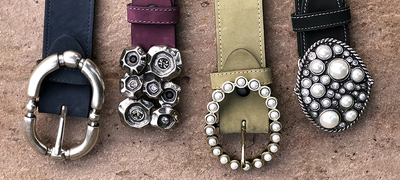
Changing the buckle is not simply a practical exercise. It is a way to recalibrate the belt for the clothes you wear and the impression you want to make. A polished silver-toned buckle has an assured place with tailored trousers, a crisp shirt and refined knitwear. A warm solid brass finish brings depth to denim, wool, corduroy and rich brown leather boots.
For evening dressing, a crystal buckle can give a narrow black or deep-toned leather strap a jewellery-like quality. It works particularly well over a simple dress, at the waist of a blazer, or with fluid tailoring where a discreet point of light is enough. The restraint lies in allowing one element to lead: if the buckle is decorative, a clean, unembellished strap gives it room to speak.
Equestrian-inspired buckles, aged-metal finishes and more sculptural shapes offer a different kind of distinction. They suit casual layers and country-inspired dressing, yet can look equally considered with contemporary separates. It depends on balance. A wider strap calls for hardware with presence, while a slimmer belt benefits from a buckle with finer proportions.
The modular approach also makes travelling easier. Rather than packing several complete belts, one or two carefully chosen leather straps and a small edit of buckles can cover daytime meetings, dinner reservations and relaxed weekends away. Keep each buckle protected, particularly if it has a plated or crystal finish.
Common Problems When Changing Buckles
If the leather fold will not close, the buckle bar may be too thick for that strap or the strap may not have been threaded around the bar correctly. Remove it and begin again rather than pressing the fastening shut. A press stud that needs excessive force is giving you useful information.
If the buckle appears crooked when worn, check whether the strap has twisted under the fold. Open the fastening, flatten the leather and realign it before refitting. When the prong does not reach the holes cleanly, look at the buckle width and the placement of the bar. Not every buckle is designed for every strap, even where the materials appear complementary.
A loose screw should be addressed before wearing the belt. Remove it, inspect the fitting and refasten with the appropriate tool. If a screw repeatedly loosens, or if the leather around a fastening appears stressed, stop using that configuration until it can be assessed. Quality hardware should feel assured, never precarious.
A well-chosen buckle gives an existing belt a new point of view. Treat the change as part of the pleasure of ownership: a small, deliberate ritual that keeps exceptional leather in regular, personal rotation.
Leave a comment