

Why English Made Leather Belts Last Longer
A belt is often the final line of an outfit, yet it is one of the hardest-working pieces in a wardrobe. It frames a tailored trouser, gives structure to a silk dress and brings authority to denim. English made leather belts are valued not simply for where they are produced, but for the considered workmanship, material knowledge and finish that allow this daily essential to become a lasting personal accessory.
For those who buy fewer, better things, the distinction is felt over time. The leather softens rather than collapses, the buckle retains its character, and the proportions continue to look right long after a seasonal accessory has been forgotten.
What distinguishes English made leather belts?
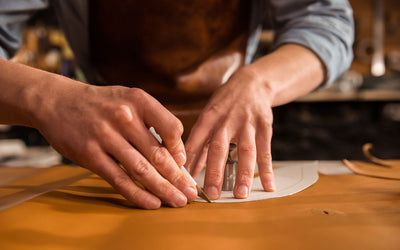
A belt made in England is not automatically exceptional. Its quality depends on the choices made at the workbench: the cut of the hide, the treatment of the edges, the stitching, the strength of the attachment and the way the hardware sits against the leather. Skilled artisan production brings judgement to each of these details.
A well-cut strap follows the natural direction of the hide, helping it retain its shape through repeated wear. Edges should feel smooth and substantial, not thinly painted to disguise a weak construction. Stitching, where used, should be neat and even, while the buckle fastening must be secure without making the belt feel stiff or cumbersome.
This is a quieter form of luxury than a conspicuous logo. It appears in the clean curve of a buckle tongue, the balance of a wide waist belt and the way a full-grain leather strap develops a rich patina. Since 1974, Clara Perri has approached belt-making as a specialist craft, combining handmade English production with leathers selected for texture, depth and wear.
Leather is where the character begins
The most compelling belts begin with leather that has genuine presence. Italian nubuck offers a soft, velvety surface and a refined matte finish, particularly elegant with knitwear, wool tailoring and relaxed dresses. Suede has a similarly tactile quality, though it benefits from more attentive care in wet weather.
Full-grain leather is prized for its strength and natural grain. It carries markings that make each strap subtly individual and, with regular use, develops rather than merely ages. Vintage calf brings a more lived-in character from the outset, making it a natural choice for casual belts worn with jeans, boots and brushed cotton trousers.
Hair-on cowhide introduces another dimension. Its texture can make a simple black trouser or plain knit feel deliberately styled, while still remaining grounded in natural material. The right choice depends on how the belt will be worn. A polished leather strap may suit a formal wardrobe best; nubuck or suede can lend softness to more relaxed looks.
Leather is not expected to remain entirely unchanged. A little darkening around frequently used holes and a gradual softening at the bend are signs of an accessory being worn well. What matters is that the material has enough integrity to age with grace.
The buckle changes more than the finish
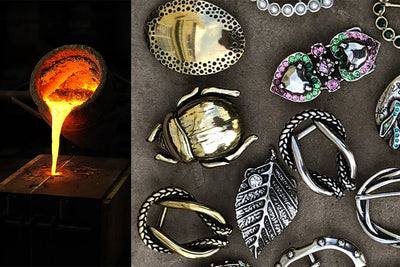
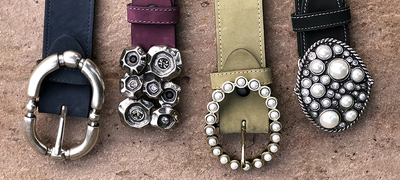
Hardware determines the mood of a belt as much as the strap does. Solid brass has warmth and weight, gradually developing its own mellow patina. Silver-plated and aged-metal finishes can create a cooler, more contemporary line, especially against black, charcoal, navy and deep brown leather. Crystal buckles bring light to an evening look, but can be equally effective as contrast against simple denim and a white shirt.
Proportion is essential. A discreet buckle on a narrow strap works beautifully through belt loops and beneath a blazer. A wider buckle has more visual presence and is often best treated as the focal point of an outfit. Equestrian-inspired hardware carries a heritage quality that complements riding boots, tailored coats and country textures, while cleaner geometric forms suit modern suiting and minimalist silhouettes.
The advantage of interchangeable buckles is that the decision need not be permanent. A single leather strap can move from a polished brass buckle for daytime to crystal or silver plating for dinner, without requiring an entirely new belt. It is a more thoughtful way to build variety: a collection of components chosen for genuine use, rather than a succession of near-identical accessories.
Choosing the right width and silhouette
A belt should work with the clothes it is intended to finish. Narrow styles are naturally versatile. They sit neatly with tailored trousers, skirts and fine knitwear, and can offer definition without taking over an outfit. Classic widths provide dependable everyday structure, while wider belts are particularly effective over dresses, longline jackets and coats where the waist needs clear emphasis.
Drop-waist belts create a different effect. Worn lower on the hip, they introduce ease and a slightly more relaxed proportion to fluid dresses, oversized shirts and longer knitwear. They should not be tightened as firmly as a waist belt. A little movement is part of their appeal.
For men, a belt’s width should relate to the trouser loop and the shoe. A substantial full-grain strap with a restrained buckle offers a reliable foundation for denim and chinos, while a more refined leather and slimmer profile suit formal trousers. There are no rigid rules, but a belt that is too narrow for heavy denim or too broad for fine tailoring can disrupt the line of an otherwise considered outfit.
Fit should be precise, not restrictive
The best-looking buckle and leather cannot compensate for an uncertain fit. Measure a belt you wear comfortably from the end of the buckle to the hole you use most often, rather than relying only on trouser size. This gives a useful reference point, particularly when choosing between waist and hip styling.
Ideally, the belt should fasten comfortably on the centre hole. This leaves room for the natural variation that comes with different fabrics, layering and styling. A belt worn over a dress may need a different size from one worn through the loops of jeans, and high-waisted tailoring will sit differently from a low-rise silhouette.
If a bespoke option is available, it is worth considering for unusual proportions, a preferred buckle placement or a strap width not easily found ready-made. Bespoke is not only about novelty. It can be the most practical route to a belt that looks composed every time it is worn.
Caring for a belt made to be worn
Good leather benefits from modest, consistent care. Hang belts by the buckle or store them loosely coiled, away from direct heat and prolonged sunlight. Avoid leaving a leather strap compressed beneath heavy items, as creasing at the same point can become permanent.
For smooth leather, a soft dry cloth removes everyday surface dust. Use products sparingly and test any conditioner discreetly first, especially on nubuck, suede and hair-on finishes, whose texture can be altered by unsuitable treatments. If a belt becomes wet, let it dry naturally at room temperature rather than placing it near a radiator.
Interchangeable buckles also deserve occasional attention. A gentle wipe with a soft cloth helps preserve the finish, while careful handling when changing components reduces unnecessary marks on both metal and leather.
A beautifully made belt earns its place through repeated use, not careful hiding. Choose the strap that suits your wardrobe, the buckle that reflects your character and the fit that feels effortless. Over the years, those decisions create an accessory that is distinctly your own.
Leave a comment